
If you own or manage a commercial property in Gilbert, Mesa, Chandler, Tempe, Scottsdale, or greater Phoenix, the roof over your building is one of the most consequential decisions you’ll make. Commercial roofing systems protect business assets and reduce operational costs, but the desert climate forces choices that property owners in milder regions never have to consider.
This guide is written for building owners, facility managers, and investors who need a practical understanding of commercial roof types, how Arizona’s heat and monsoon storms affect performance, and what to evaluate before committing to a roofing system. Advanced Precision Roofing specializes in flat and low-slope commercial roofing, spray polyurethane foam (SPF), and elastomeric roof coatings across the East Valley.
Here is what this article covers:
- What qualifies as a commercial roof and how it differs from residential roofing
- The main commercial roofing systems used on flat roofs in Arizona
- How Arizona heat, UV, and monsoon rain affect every system differently
- Drainage, penetrations, and the details that cause most leaks
- When to replace, restore, recoat, or repair
- How to compare proposals and choose a contractor
What Counts as a Commercial Roof on a Commercial Building?
A commercial roof is defined by how the building is used, not just its size. Offices, retail centers, warehouses, schools, churches, light industrial facilities, apartment buildings, and multifamily complexes all fall into this category. Factors to consider when choosing a roof include building structure, climate, and budget, and these factors become more complex on commercial properties than on a single-family home.
Common commercial roof shapes in the East Valley include:
- Flat roofs and very low-slope commercial roofs designed to move water toward drains or scuppers, common on retail centers, warehouses, and other commercial buildings throughout the East Valley
- Low slope roofs up to roughly 3:12 pitch, used on many commercial buildings where drainage is provided by the roof slope and drainage system
- Less-common steep slope roofs on some churches or mixed-use buildings, which may use tile roofing or other residential roofing materials in Gilbert
Flat or low-slope roofs can accommodate rooftop equipment like HVAC units and solar panels, walkways for service personnel, satellite and communications gear, and safety rails. These functional demands require roofing materials built for heavy use and wide exposure.
Commercial roofing materials must comply with applicable building codes, fire requirements, and energy provisions. The requirements that apply depend on the building, roofing system, scope of work, and local jurisdiction.
Why Flat Roofs & Low-Slope Roofs Need Different Systems Than Steep Roofs
Commercial roofing systems typically require specialized materials for flat or low-slope roofs because water behaves differently on a nearly level surface. Steep slope roofs rely on gravity and overlapping materials like asphalt shingles or barrel tile to shed rain quickly. Flat roofs shed water slowly and depend entirely on slope to drains, scuppers, or gutters.
Flat roofs are cost-effective to build and install and require less material due to fewer square feet of surface compared to a pitched equivalent, but flat roofs can suffer from poor drainage, leading to water damage. Even small errors in slope or drain placement can create chronic ponding. Water that remains on the roof after the drainage system has had time to work should be evaluated because persistent ponding can accelerate deterioration and expose weaknesses in the roofing system.
Common steep-slope materials are not appropriate for dead-flat conditions. Asphalt shingle roofing systems and concrete tiles are designed to overlap and shed water at steeper angles. On a flat roof, they allow water intrusion and eventually fail.
Instead, flat roofs require continuous, watertight systems:
- A roofing membrane (single-ply, built up roofing, or modified bitumen) that forms a sealed surface
- Foam roofing systems that create seamless, insulated waterproofing
- Liquid applied roofing systems such as elastomeric coatings over a sound substrate
Low-sloped roofs allow for better water runoff than completely flat roofs, and pitched roofs reduce the risk of water buildup and leaks. But even on low slope roofs, the system must be fundamentally different from what works on a steep residential structure.
Main Commercial Roofing Systems Used on Flat Roofs in Arizona
Several types of commercial roofing systems are used on flat and low-slope commercial buildings in Arizona. Service life varies widely by roofing system, installation quality, climate exposure, drainage, maintenance, and the condition of the underlying roof assembly.
Here are the main systems you will encounter:
- Spray polyurethane foam roofing (SPF): Seamless foam applied over existing substrates, coated with reflective elastomeric coatings. Strong insulation and waterproofing.
- Elastomeric roof coatings: Fluid-applied coatings (acrylic, silicone, urethane) used to restore or protect foam, BUR, modified bitumen, or other membranes.
- Single-ply membranes (TPO, PVC, EPDM): Factory-manufactured sheets installed in single layers, heat-welded or adhered. Common on new construction.
- Built up roofing (BUR): Multiple layers of asphalt and reinforcing fabrics with gravel or cap sheet. A legacy system still found on older buildings.
- Modified bitumen roofing: Polymer-modified asphalt rolls installed in multiple layers. Durable and widely used.
- Metal roofing systems: Panels on slightly pitched roofs, including standing seam roofing and corrugated galvanized steel. Less common on dead-flat structures.
Advanced Precision Roofing focuses on foam roofing systems, roof coatings, drainage correction, waterproofing, restoration, and replacement for flat and low-slope commercial roofs rather than every commercial roofing type on this list.
Spray Polyurethane Foam Roofing Systems (SPF)
Spray polyurethane foam roofing is a closed-cell foam sprayed directly onto a properly prepared substrate. As it expands, it forms a seamless, adhered, insulated roof surface that conforms to various roof shapes and penetrations without joints or seams.
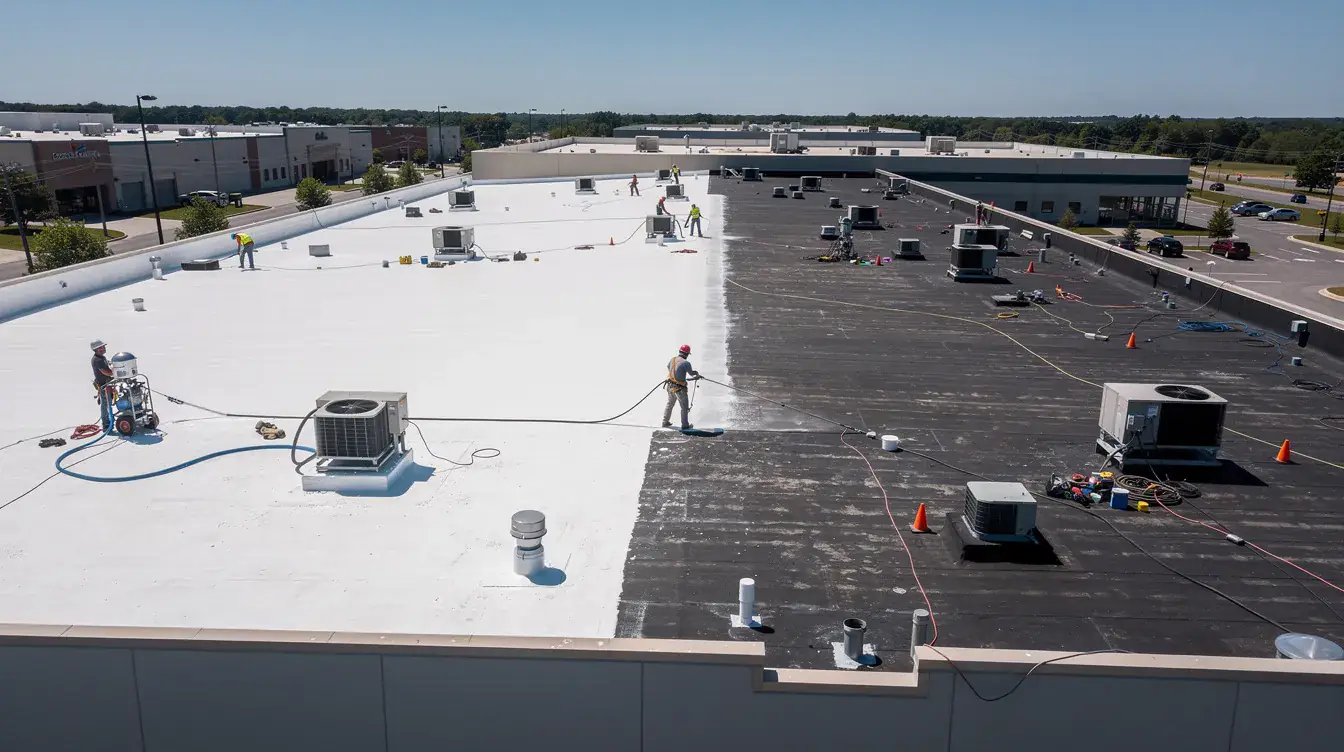
The components of an SPF roof assembly include the existing substrate (cleaned, dried, and primed), the SPF layer itself, a protective elastomeric coating (typically white and reflective), and optional broadcast granules for UV protection and wear resistance in high-traffic areas.
SPF offers several advantages for Arizona commercial properties:
- Excellent insulation performance, with closed-cell spray foam commonly providing a high R-value per inch and helping reduce heat transfer through the roof
- Seamless waterproofing that self-flashes around HVAC curbs, pipes, and penetrations, eliminating many common leak points
- Ability to correct minor slope and ponding issues by building up low areas without structural changes
- High reflectivity when an appropriate reflective coating is used, helping reduce roof surface temperatures during Arizona’s extreme summer heat
Limitations and considerations for SPF in the East Valley:
- The substrate must be dry and structurally sound. Foam traps moisture if applied over a wet deck.
- The protective coating requires ongoing maintenance. Depending on coating type and thickness, recoating may be needed periodically to maintain UV protection.
- Installation requires trained, experienced applicators and careful overspray control near adjacent properties and vehicles.
- Not every existing roof is a candidate. Widespread saturation or failed decking may require tear-off before foam can be applied.
Typical use cases include re-roofing older built up roofing or modified bitumen on shopping centers, offices, and small industrial buildings in Gilbert and the East Valley where the owner wants to upgrade insulation and avoid full tear-off. A well-installed SPF system with scheduled recoating can last 30 or more years.
Elastomeric Roof Coatings & Foam Roofing System Maintenance
Elastomeric roof coatings are fluid-applied roofing materials used over foam, built up roofing, and some single-ply systems to form a seamless waterproof and UV-protective layer. Common formulations include acrylic, silicone, and urethane coatings. Each has different performance characteristics for adhesion, ponding resistance, and flexibility.
On an SPF roofing system, the elastomeric coating serves as the sacrificial protective layer. It shields the foam from UV degradation, adds reflective properties that lower rooftop temperatures, and provides the waterproof surface that keeps water out. Without it, raw foam degrades quickly under Arizona’s intense sun.
Arizona-specific benefits of reflective coatings:
- Reflective roof coatings can provide high solar reflectance and help reduce roof surface temperatures; actual performance depends on the specific coating product, condition, and complete roof assembly
- Reduced thermal stress on the roof assembly, which slows seam fatigue and cracking
- Reduced heat gain through the roof can help lower cooling demand during Arizona’s hottest months
Coatings are not a cure-all. The existing roof must have a sound substrate, adequate drainage, and proper installation. Coatings can bridge small cracks and surface wear, but they cannot solve structural problems, saturated insulation, or severely deteriorated membranes.
The maintenance cycle for an SPF + coating system requires ongoing maintenance:
- Regular inspections, with additional checks after significant monsoon or wind events
- Cleaning debris from the roof surface and drains
- Repairing small blisters, punctures, or mechanical damage promptly
- Recoating at manufacturer-recommended intervals based on coating type, film thickness, and wear patterns
- Documenting condition over time to plan recoating before the foam becomes exposed
Other Common Commercial Roofing Types (TPO, PVC, BUR, Mod Bit, Metal)
Advanced Precision Roofing does not install every system below. Some existing commercial roof systems may qualify for restoration with foam or protective coatings when the substrate, attachment, moisture condition, and system compatibility are suitable. Here is an objective comparison of common commercial roofing types found on flat and low-slope buildings in the East Valley.
Built up roofing (BUR):
- Built-up roofing systems have been used for over 100 years and consist of multiple layers of asphalt and reinforcing fabrics topped with gravel or a cap sheet
- Common on older Phoenix warehouses, schools, and industrial buildings
- Heavy and durable, with exceptional durability when maintained, but hot to install and rigid under extreme thermal cycling
Modified bitumen roofing:
- Modified bitumen systems are installed in multiple layers for durability using cold adhesives, heat welding, or self-adhering sheets
- Modified bitumen is an established low-slope roofing material used on commercial and industrial buildings
- Modified bitumen roofing is waterproof and resistant to leaks, with good impact resistance for rooftop foot traffic
- It consists of multiple layers for enhanced durability, making it a reliable industrial roofing material
Single-ply TPO:
- TPO is a widely used thermoplastic single ply roofing material for low-slope commercial roofs
- TPO roofing reflects sunlight, reducing cooling costs on large distribution centers and big-box retail
- Heat-welded seams; lightweight and cost effective for new construction on flat roofs
Single-ply PVC:
- PVC roofing, made from polyvinyl chloride, is available in reflective formulations that can support energy-efficient roof designs
- PVC roofs provide excellent resistance to chemicals and are suitable for industrial use, making them common on restaurants and food plants where grease exposure is a concern
- Strong chemical resistance and durable heat-welded seams
EPDM roofing membrane:
- EPDM is a common thermoset membrane used in single ply roofing-a black synthetic rubber
- EPDM roof service life depends on membrane specification, installation quality, climate exposure, detailing, and proper maintenance
- More common in other regions than Arizona because it absorbs heat, though it remains flexible and durable
Single-ply membranes are commonly used for low-slope commercial roofs. These single ply roofing systems include thermoset and thermoplastic membranes and are generally lightweight compared with multi-layer asphaltic systems. Maintenance requirements and durability depend on the specific roofing membrane, attachment method, seams, flashing details, exposure, and workmanship.
Metal roofing systems:
- Metal roofing systems can provide long service life when properly designed, installed, and maintained, with performance varying by panel system, coating, exposure, and detailing
- Reflective metal finishes can support energy efficiency, while wind and weather performance depend on the specific metal roofing system, fastening, edge details, and installation
- Standing seam roofing and corrugated galvanized steel panels are used on slightly pitched commercial structures
- Metal roofing systems require minimal maintenance compared to others, but thermal expansion is a concern on large spans, and they provide less insulation unless combined with insulation boards underneath
Some aging BUR, modified bitumen, and single-ply roofs in the East Valley may be candidates for foam roofing or coating restoration instead of full roof replacement when the existing roof is sufficiently dry, sound, well attached, and compatible with the proposed system.
Green Roofing Systems & Energy Performance in the Desert
Green roofing systems are vegetative roofing systems installed above a waterproofing membrane with drainage components, growing media, and plants. Green roofs can help manage stormwater, add thermal mass, and change rooftop heat performance, but they also add structural, irrigation, waterproofing, and maintenance requirements.
Full vegetative roofs are less common in metro Phoenix because water use, structural weight, waterproofing complexity, and maintenance must be carefully considered. Green roofs provide natural insulation and other building-performance benefits, but in the desert they require a very different design and maintenance strategy from reflective cool-roof systems.
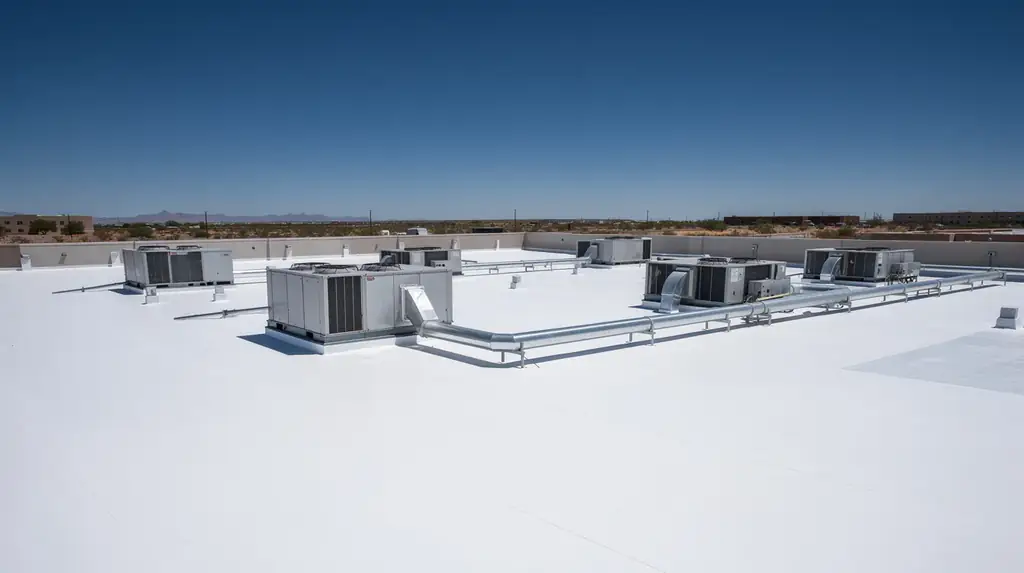
More common energy-focused solutions for Arizona commercial roofs include:
- High-albedo white coatings over SPF or other membranes that serve as protective coatings against UV while reducing surface temperatures
- Proper insulation using polyiso boards, cover boards, or SPF for excellent insulation performance
- Integration with solar panel arrays where roof structure and membrane allow
- Cool roofs use reflective properties to reduce solar heat gain, which can lower roof temperatures and cooling demand depending on the building and roofing system
Reflective roofing materials can reduce solar heat gain and support lower cooling loads. Applicable energy-efficiency requirements may specify insulation or reflectivity performance depending on the project and jurisdiction. Reflective surfaces and appropriate insulation are common strategies in energy-efficient commercial roofing systems.
Choosing the right roofing system requires balancing energy performance, waterproofing, drainage, maintenance, structural capacity, and life-cycle cost. Any green roofing or overburden system also requires proper installation details for drainage, root protection, waterproofing, and structural load.
Green roofs provide natural insulation, but for many East Valley commercial properties, reflective roof coatings and appropriate insulation are more practical energy-efficiency strategies. The best commercial roofing materials still depend on the existing roof, building use, drainage, budget, and long-term maintenance plan.
Arizona Climate Challenges: Heat, UV, Monsoon Rain & Thermal Movement
The durability of commercial roofs strongly depends on climate and maintenance, and Arizona tests both relentlessly. Understanding how the desert attacks roofing materials is essential to making a good decision for your commercial roofing project.
Extreme heat and UV: Arizona commercial roofs experience prolonged summer heat and intense UV exposure. High roof surface temperatures accelerate UV degradation, oxidation of asphalt-based roofing materials, and aging of sealants and flashings. High quality roofing materials with reflective properties and strong UV protection can help manage these conditions.
Thermal expansion and contraction: Repeated heating and cooling creates movement throughout the roof assembly. Seams, flashings, fasteners, sealants, and penetrations must be detailed to accommodate that movement without compromising waterproofing.
Monsoon season: Intense localized storms, wind-driven rain, and windblown debris can quickly test drainage capacity and expose weak flashing or waterproofing details. Debris can also obstruct drains and scuppers, increasing the risk of ponding water.
Ponding water: Persistent standing water can accelerate deterioration, collect dirt and debris, and increase loading on the roof assembly. On flat roofs in the East Valley, recurring ponding is a reason to evaluate roof slope, drains, scuppers, low areas, and the condition of the existing roofing system.
SPF and coatings perform well in this climate when correctly designed: the ability to improve slope in localized low spots, high reflectivity, and seamless waterproofing that tolerates thermal movement give them advantages for retrofit projects on existing buildings.
Drainage, Parapet Walls, Scuppers, and Penetrations on Flat Roofs
Many commercial buildings in the East Valley use parapet walls, internal drains, through-wall scuppers, gutters, or combinations of these features to move water off broad roof areas. When these systems function correctly, water moves off the roof within hours. When they do not, the problems multiply.
Poor drainage results from:
- Insufficient slope toward drains or scuppers
- Clogged drain strainers blocked by dust, leaves, or monsoon debris
- Undersized, obstructed, or poorly detailed scuppers that restrict water flow during heavy rain
- Settled insulation, compressed deck, or crushed insulation beneath rooftop equipment
- New HVAC installations or equipment pads that block original drainage paths
Proper installation and detailing around penetrations is critical:
- Roof drains, scuppers, and overflow provisions must be sized and detailed according to the building design and applicable code requirements
- Through-wall scuppers and downspouts must be clear and properly sealed
- HVAC curbs, pipe penetrations, electrical conduit, and vent stacks each need properly adhered flashing and sealant
- Transitions at parapet walls, expansion joints, and equipment pads require flexible, weather-tight connections
Many commercial roof leaks originate at details and penetrations rather than in the field of the membrane or foam. A clogged scupper on a strip mall after an August storm is a textbook example-water backs up behind the parapet, finds a gap in the flashing, and enters the building far from the actual entry point.
Advanced Precision Roofing evaluates and can improve drainage performance when installing foam roofing or coating systems, within the constraints of existing structure and code.
Replacement vs. Restoration vs. Recoating vs. Repair
Understanding the difference between these four options is one of the most important decisions for any commercial property owner.
- Full roof replacement: Tear-off to an appropriate substrate followed by installation of a new roofing system. Replacement may be necessary when there is widespread saturation, significant system failure, deteriorated decking, incompatible existing materials, or other conditions that make restoration impractical.
- Restoration: Installing foam roofing systems or compatible coating systems over a qualifying existing roof to extend its useful life. Restoration may be appropriate when the existing roof is sufficiently dry, securely attached, structurally sound, and compatible with the proposed restoration system.
- Recoating: Renewing the protective elastomeric coating on an existing SPF or compatible coated roof. When the foam or underlying system remains sound and dry, recoating can restore UV protection and extend service life without the scope of a complete roof replacement.
- Commercial roof repair: Localized repair is one possible response to an isolated defect, but repeated commercial roof repair can indicate a broader system problem. Advanced Precision Roofing currently focuses on complete roof systems, waterproofing, restoration, recoating, and replacement rather than small patch repairs.
Advanced Precision Roofing evaluates the existing roofing system, visible substrate conditions, drainage, penetrations, and waterproofing details before recommending a solution. Findings are documented with photos and a written scope so the property owner can understand what is being recommended and why.
Common Causes of Commercial Roof Leaks in the East Valley
Regular inspections are necessary for maintaining the performance of commercial roofing systems. Most leaks share predictable causes:
- Failed or poorly installed flashing at HVAC curbs and penetrations
- Cracked sealant at pipes, conduit, and antenna mounts
- Open seams at membrane terminations or base flashings
- Ponding water in areas where water has stood for weeks or months, deteriorating the membrane
- Mechanical damage from foot traffic, dropped tools, or careless equipment installation
- Aging coatings or exposed foam where the elastomeric layer has worn away
Monsoon winds drive rain horizontally into openings that may never leak during light, vertical rain. Many leaks show up inside the building far from the actual entry point because water travels along decks, purlins, or insulation before dripping to the ceiling.
If you notice staining, drips, or musty odors during or after storms, a professional commercial roof inspection can help identify the source and determine whether the issue points to an isolated defect or a broader roofing-system problem; scheduling a free commercial roof inspection in the East Valley allows issues to be documented and evaluated before they escalate.
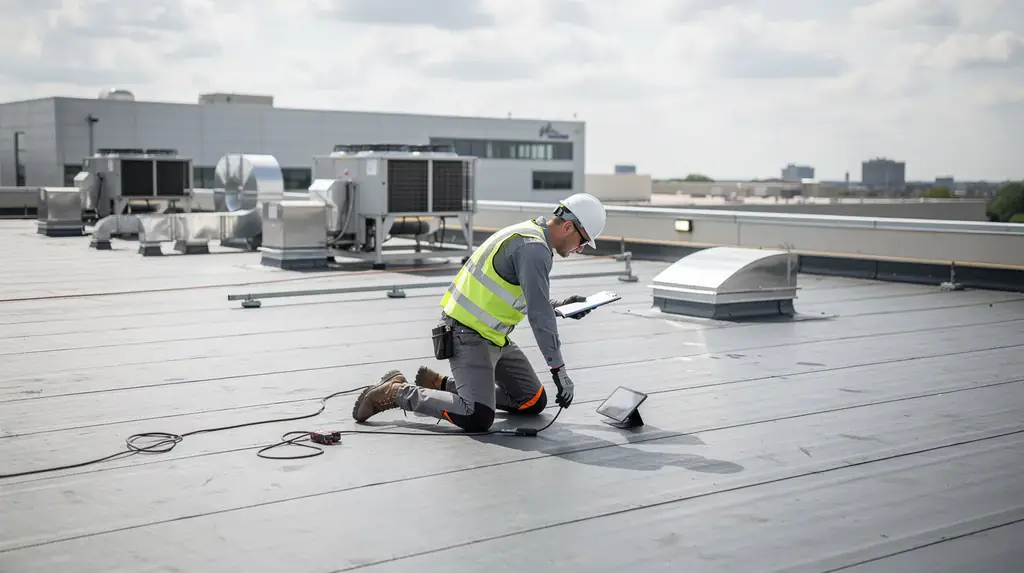
Commercial Roof Inspections: What Should Be Evaluated?
A professional commercial roof inspection in Gilbert or Mesa should go far beyond looking for obvious holes. The goal is to evaluate the entire roof assembly and identify problems before they cause leaks or structural damage.
Key inspection elements include:
- Overall roof slope and signs of ponding (stain rings, algae lines, dirt deposits marking water lines)
- Condition of roofing materials-foam, coatings, membranes, or built up roofing-including blisters, alligatoring, cracks, and exposed reinforcing fabrics
- Moisture evaluation where appropriate, using methods suited to the existing roofing system and project scope to identify suspected wet insulation or substrate problems
- Flashing and detail review around parapet walls, penetrations, drains, scuppers, and rooftop equipment
- Condition and capacity of drains, strainers, gutters, and downspouts, with evidence of overflow or backups
- Previous repairs, patches, and transitions between different roofing types
Advanced Precision Roofing documents findings with photos and clear explanations so owners can see exactly what is happening on the roof surface and make informed decisions.
How Commercial Roofing Costs Are Determined
Commercial roofing costs are driven by several measurable factors, not a single per-square-foot number that applies universally. Understanding these drivers helps you evaluate proposals realistically.
Main cost factors:
- Roof size in square feet
- Number of existing roofing layers and whether tear-off is required
- Type of roofing system selected (foam roofing systems, single ply membranes, built up roofing, etc.)
- Required insulation R-values and whether tapered insulation or foam is needed to improve drainage
- Complexity of details: number of penetrations, parapet height, skylights, and rooftop units
- Access, safety requirements, and staging-a downtown building with limited access differs from an open industrial park lot
Restoration or recoating can sometimes reduce cost compared to full tear-off when code and existing conditions allow. But the cheapest option upfront is not always the most cost effective over the building’s life.
When comparing options, think about life-cycle cost: energy performance from insulation and reflectivity, expected service life of the system, maintenance and recoating needs, and the likelihood of needing commercial roof repair over the life of the roof.
Comparing Commercial Roofing Proposals & Choosing a Contractor
When you receive multiple bids for a commercial roofing project, comparing them requires more than looking at the bottom line.
Proposal comparison checklist:
- Confirm all contractors are proposing the same scope: tear-off vs. overlay, thickness of foam, type and thickness of roof coatings, or type of single-ply roofing membrane
- Look for specific details on substrate prep, flashing work, and drainage corrections-not just brand names
- Review proposed roofing materials and coating types, and confirm compatibility with the existing roofing system
- Check whether the proposal addresses known problem areas like ponding, worn flashings, or clogged drains
Contractor evaluation:
- Experience with flat roofs and foam roofing in Arizona’s climate, not just residential roofing or steep-slope work
- Clear inspection reports with photos documenting current conditions
- Licensing (ROC in Arizona) and insurance appropriate for commercial work
- Local references for projects on similar commercial building types in the East Valley
Advanced Precision Roofing is a family-owned contractor with direct owner involvement in every project. The focus is on durable, long-term commercial waterproofing solutions rather than a one-size-fits-all approach.
When to Call Advanced Precision Roofing for Your Commercial Roof
If any of these situations apply to your building, it is time to have your roof professionally evaluated:
- Recurring leaks that persist despite repeated repairs
- Visible ponding water that remains after storms
- Aging foam or coatings that appear chalky, cracked, or worn through
- Planned tenant improvements that will add rooftop equipment or penetrations
- Buying or selling a commercial building and needing documentation of roof condition
- Planning solar installation on a flat roof and needing to verify the existing roofing system can support it
Advanced Precision Roofing focuses on:
- Commercial flat roof inspections in Gilbert and the East Valley
- Spray polyurethane foam roofing systems for suitable existing roofs
- Elastomeric roof coatings, recoating, and restoration
- Drainage and waterproofing detail improvements on existing roofs
The right commercial roofing decision starts with understanding what is already on your roof and what Arizona’s climate demands from it. Schedule a photo-documented inspection and consultation to evaluate whether repair, recoating, restoration, or full replacement is the most appropriate path for your specific building. Contact Advanced Precision Roofing to get started.


